

Attendance
28 faculty, staff, and administrators.
Topic
Theme #2 – Embrace AI Integration & Adaptation While Preserving Human Connection.
Who will our students be in 2035?
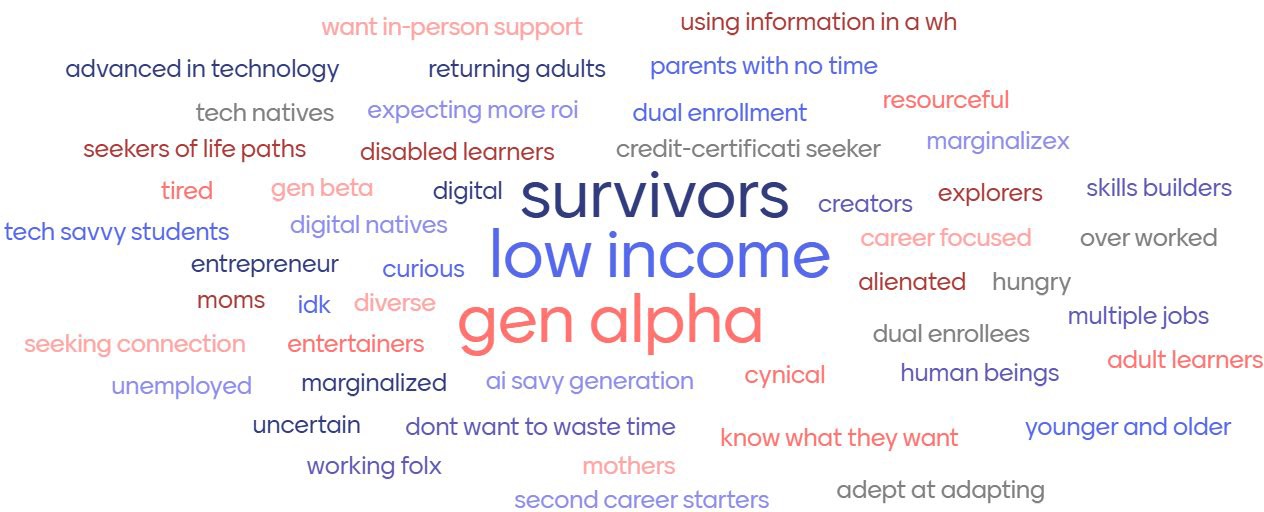
How can we ensure we are creating just, equitable futures for our students?
Attendee input fell largely into three categories: 1) centering the student voice and experience; 2) considering external influences and partnerships; and 3) ensuring equity in technology.
|
Center Student Voice |
Consider External Influences |
Technology |
|---|---|---|
|
Assess students’ needs; Create space for meaningful conversation and validate their lived experiences Stay in contact with students to ensure we’re on the right track Collect data around what students are asking for/saying they need and then act on that feedback Keep student involvement at the center of our processes Ensure programs and pathways meet the students’ needs; Provide training for the relevant skills, not just the areas we deem worthy Provide supports to meet students where they are Plan for our DI community Provide standards and expectations for all students |
Get feedback from local businesses to translate needs into course content and experiences for students Let’s look at our vendor partnerships. Do our partnerships align with our communities? Refuse to capitulate to external pressures and political dynamics that are actively working to undermine our efforts None of the outside world is going to change and our influence may be minimal, but we can ensure students have the critical thinking skills as well as knowledge of issues We can only control our ecosystem, which is small Modify our assessment and teaching to suit future workforce needs |
Everything starts with access. Technology must be in the hands of our students to be successful in courses but also so they can navigate these digital issues. Bye bye digital divide Ensure AI/Computer/Data Storage and Digital Privacy for every student |
How will advancing technology impact our students and our work?
Attendees noted significant impacts to teaching and learning, as well as in delivering student support and managing day-to-day operations of the college.
| Impact on Teaching & Learning | Impact on Student Support & Campus Operations |
|---|---|
|
If we allow it to, technology has the potential to accelerate the decades-long movement away from relational teaching and learning toward transactional teaching and learning Classrooms will become more Socratic Seminar style, where the students will do the teaching. Our job will be to become comfortable in the learner’s seat Teachers will act more as facilitators and mentors than lecturers We will need to reimagine the classroom. The current version and use of classrooms might be very different. Maybe learning happens outside/online but connection building occurs in classroom spaces Things will flip, labs will become spaces to connect with each other rather than a place to connect with technology. People will need experience on how to interact |
It will give us the opportunity to do “busy work” more quickly so we can focus our time on human interactions/ connections Many technologies will be essential. Students will need these to survive just like other basic necessities. Digital skills and tech inequality will impact student success More career focus with less work |
Attendees also reflected on how advancing technology might alter how individuals make meaning, make decisions, and connect with one another. Some comments include:
- A deeper challenge to preserve meaning, attention, and human connection
- Externalization of knowledge will change cognitive structures and affect higher level thinking skills
- A struggle between embracing technological efficiency and the value of human capital
Discussion: Key Attendee Recommendations
- Change theme title to emphasize human connection first. Suggestions included:
- “Center Human Agency in the Age of AI”
- “Center Human Connection in an Era of AI-Driven Change”
- “Center and Build Human Connection, Augmented by Advanced Technologies”
- “Build Human Connections and Agency in the Era of Advanced Technologies”
- “Center Human Connection in an AI-Integrated World”
- Centralize values rather than strategies. Think about what students, faculty, and staff need, not what they will do.
- Consider the distinction between “Artificial Intelligence” and “Augmented Intelligence.” Shouldn’t the college seek to use to AI to enhance, not supplant, human intelligence?
- MCC may need to move from a focus on disciplinary knowledge (which AI can already train) toward cultivating better, more human-centered leaders, critical thinkers, ethical citizens, etc.
- Each program will need to wrestle with their own approach to AI, with some disciplines experiencing greater job displacement due to AI or significant transformation in the workforce
- Consider including Virtual Reality (VR) and other advanced technologies in this theme


