

Attendance
28 faculty, staff, and administrators.
Topic
Theme #3 – Strengthen Industry Partnerships & Workforce Alignment Theme #4: Foster Interdisciplinary & Human-Centered Skills Learning.
What three skills will a student who graduates from MCC in 2035 need to be successful in tomorrow’s careers?
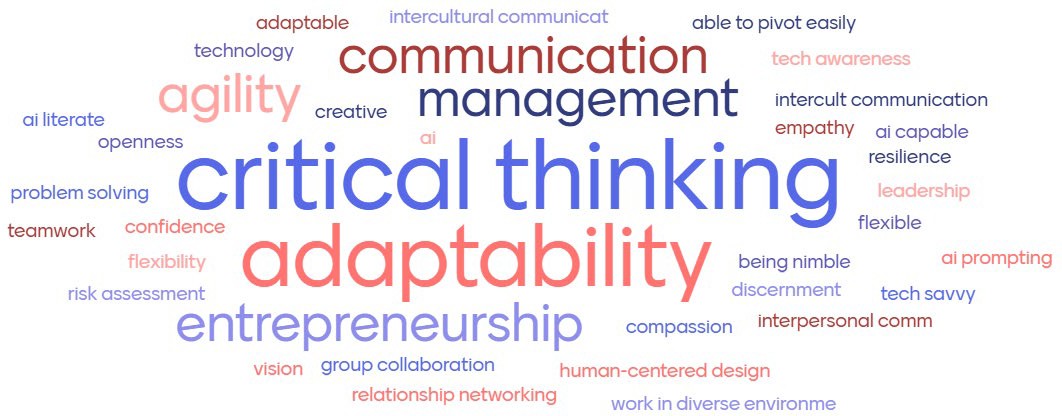
What’s one way MCC can partner with industry to help graduates build wealth and economic security?
Attendee input fell largely into three categories, with a particular focus on addressing inequities in workforce development and intentionally connecting DI communities to high-wage fields.
|
Work-Based Learning & Industry Programming |
Employer Engagement & Communication |
Curriculum & Programs |
|---|---|---|
|
Internships and apprenticeships Job shadowing or mentoring by professionals Education on investments (Roth IRAs, stocks, etc.) Showcase your work to a student week More events like the Industry Advisory Board meetings Programming to help the oceanside community understand what a thriving wage and good job actually means Institutional mentorships, cohort models, professional development for students – conventions and professional organizations |
Only allow employers to access students on campus if they provide a living wage to graduates Constant communication and outreach; follow up on the successes of graduates and report back to industry showing the ROI Take up educating employers about how their practices may further marginalize students Listen to industry when they say what they need. If CCs won’t listen, Google, Microsoft, or Grand Canyon University will Have employers participate in program review; focus on ROI Advocate for wage transparency |
Sunset programs that do not lead to a living wage Industry co-teachers Design courses with an internship component Celebrate part-time faculty who often have one foot in industry and the other in the classroom |
What’s one bold way to create truly integrated, interdisciplinary learning?
Attendees recommended greater customization of paths to completion and opportunities to foster common intellectual experiences for all MCC students both in- and outside of the classroom.
Attendees also noted significant equity implications in theme #4 and suggested leveraging the expertise from programs like Ethnic Studies that are interdisciplinary in nature and can support the exploration of the history and implications of systems in all disciplines at the college.
| Program & Pathway Customization | Shared Learning Experiences via Instruction, Student Services, and Campus-Wide Programming |
|---|---|
|
Get rid of “pathways” and “programs” and reorganize to instead ask students what they want to know or solve, and design customized paths with student input Let students choose their own path with structured choices Shift from pathways toward skills Allow students to choose a combo of courses that mix multiple disciplines into a single degree Deemphasize majors and emphasize skills, approaches, ways or thinking and knowing |
Identify overlaps across SLOs to characterize common skills Ask each program to articulate the wicket problem their program addresses Amend the contract to encourage faculty engagement Capstone projects across disciplines This may get in the way of requirements in CORs since those lock curriculum in and narrow the focus “Hackathon” style competition to showcase MCC leadership for interdisciplinary problem solving Fund participatory action research Engage classified and management in project-based learning Campus-wide theme weeks that encourage all disciplines to relate assignments to that theme (example, earth week). Student employment with intentional learning outcomes |
Discussion: Key Attendee Recommendations
- AI cannot teach the skills we anticipate students will need; need to ensure this shows up in our value proposition for our future students
- Consider the role of the community college in helping students become good people and contributing citizens – need to think about the skills that reach beyond the individual to the benefit of the collective, like advocacy, social awareness, organizing, etc. This also applies to thinking about industry partnerships not as what is best for industry, but rather what is best for the community more broadly.
- There are indications in the market that capital investments are increasing at the same time hiring is decreasing. Many believe the increase in the S&P 500 is related to investor optimism in generative AI, while the decrease in total job openings is related to the offloading of work to AI and automation. creating a potential “AI bubble” that could have significant implications not only for students, but for the economic conditions affecting the communities we serve more broadly.


